
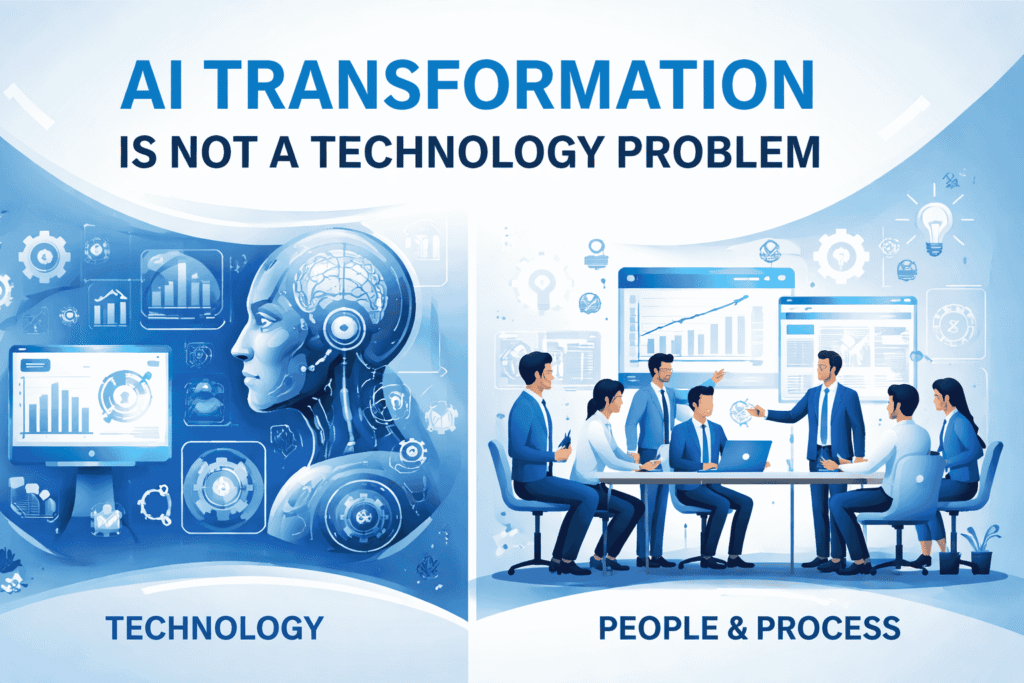

AI Transformation Is Not a Technology Problem, Artificial Intelligence (AI) is changing how businesses paintings. Many companies think that adopting AI is pretty much shopping for the right tools or software program. But, the fact is distinct.
AI transformation isn’t a era hassle—it’s far a people, procedure, and mind-set mission.
In this text, we will discover why AI transformation is going beyond generation, what challenges agencies face, and a way to correctly implement AI in a realistic and sustainable manner.
What Does “AI Transformation Is Not a Technology Problem” Mean?
Whilst we are saying AI Transformation Is Not a Technology Problem, we suggest that:
- The gear exist already
- The actual venture is how people use them
- Achievement relies upon on lifestyle, management, and strategy
Many businesses invest in superior AI structures but fail to notice outcomes. This occurs due to the fact they cognizance only on generation rather than changing how their business works.
Why Companies Misunderstand AI Transformation
Many companies make the mistake of wondering AI is pretty much:
- Putting in software
- Hiring information scientists
- Automating obligations
But AI transformation is lots bigger. It involves:
- Changing choice-making strategies
- Training personnel
- Remodeling workflows
- Building a records-driven subculture
With out these changes, even the excellent AI gear will no longer supply price.
Key Challenges in AI Transformation
1. Lack of Clear Strategy
Many businesses leap into AI without a clean plan.
Problems:
- No defined dreams
- No success metrics
- Random AI initiatives
Solution:
- Start with enterprise problems, not technology
- Define measurable outcomes
2. Resistance to Change
Employees regularly fear AI due to the fact they assume it’ll update them.
Common concerns:
- Process loss
- Expanded complexity
- Lack of awareness
Solution:
- Teach groups about AI
- Display how AI enables, not replaces
- Inspire collaboration
3. Poor Data Quality
AI relies upon on statistics. If the facts is awful, effects will be bad.
Issues include:
- Incomplete records
- Erroneous statistics
- Records silos
Solution:
- Enhance facts management
- Create centralized records systems
- Make sure facts accuracy
4. Skills Gap
Not all personnel are geared up to work with AI gear.
Challenges:
- Lack of technical knowledge
- No schooling programs
- Limited expertise of AI
Solution:
- Invest in training
- Upskill existing personnel
- Build cross-purposeful teams
5. Leadership Misalignment
AI transformation requires strong management.
Issues:
- Leaders do not recognize AI
- Loss of imaginative and prescient
- Negative communique
Solution:
- Teach leadership
- Align AI dreams with business desires
- Promote innovation
AI Transformation vs Traditional Technology Adoption
| Aspect | Traditional Technology | AI Transformation |
|---|---|---|
| Focus | Tools and systems | Business value |
| Approach | One-time setup | Continuous improvement |
| Role of People | Limited | Critical |
| Decision Making | Manual | Data-driven |
| Change Required | Low | High |
This desk suggests why AI transformation is not just another IT project.
Steps to Successfully Implement AI Transformation
Step 1: Define Business Goals
Begin with clear targets.
Examples:
- Improve customer service
- Increase sales
- Lessen prices
Step 2: Build a Data Strategy
Statistics is the foundation of AI.
Actions:
Gather applicable statistics
Smooth and organize statistics
Ensure information protection
Step 3: Focus on People
People are the maximum important a part of AI transformation.
What to do:
- Educate employees
- Create focus
- Inspire getting to know
Step 4: Start Small
Do now not attempt to transform the whole lot right now.
Best approach:
- Begin with small AI projects
- Check outcomes
- Scale step by step
Step 5: Change Business Processes
AI calls for new approaches of running.
Examples:
- Automating repetitive obligations
- The usage of statistics for selections
- Enhancing workflows
Step 6: Measure and Improve
Music overall performance often.
Metrics to track:
- ROI (go back on investment)
- Performance upgrades
- Client delight
Real Benefits of AI Transformation
When achieved correctly, AI transformation offers many benefits:
1. Better Decision Making
Facts-pushed insights
Quicker decisions
2. Increased Efficiency
Automation of ordinary obligations
Reduced manual work
3. Improved Customer Experience
Customized offerings
Quicker responses
4. Competitive Advantage
Live ahead in the market
Innovate faster
Common Mistakes to Avoid
Here are some mistakes groups need to avoid:
- Focusing best on tools
- Ignoring worker training
- Starting without a strategy
- Anticipating brief effects
- Now not measuring overall performance
Averting these errors can drastically boom the fulfillment rate of AI transformation.
Role of Culture in AI Transformation
Way of life performs a main role in success.
A strong AI-pushed tradition consists of:
- Openness to exchange
- Willingness to experiment
- Collaboration among teams
- Continuous getting to know
Without the right way of life, AI initiatives regularly fail.
AI Transformation in Medium-Level Businesses
Many discussions approximately ai transformation now not era trouble medium attention on mid-sized groups.
Challenges for Medium Businesses:
- Restricted budget
- Lack of expertise
- Fear of danger
Opportunities:
- Faster decision-making
- Less difficult adoption of exchange
- Ability to scale quick
Tips for Medium Businesses:
- Awareness on high-impact regions
- Use inexpensive AI gear
- Associate with experts
- Teach inner teams
Medium agencies can reach AI transformation in the event that they awareness on approach instead of generation alone.
FAQs
Q1. Why is AI transformation not just a technology problem?
Because success depends on human beings, tactics, and strategy—not just equipment.
Q2. What is the biggest challenge in AI transformation?
The largest task is exchange management, together with employee attitude and organizational way of life.
Q3. Can small or medium businesses adopt AI?
Yes, they could. by starting small and focusing on business wishes, even smaller companies can advantage from AI.
Q4. How long does AI transformation take?
It’s far an ongoing process. it could take months or years depending on the scale.
Q5. Do companies need experts for AI transformation?
Yes, but they need to also teach their existing personnel to build lengthy-time period functionality.
Conclusion
AI is strong, but it isn’t magic. Many corporations fail because they deal with AI as a generation improve as opposed to a enterprise transformation.
The key message is obvious:
AI Transformation Is Not a Technology Problem—it’s far a human and organizational mission.
To succeed, businesses must:
- Awareness on humans and lifestyle
- Build robust records foundations
- Align AI with enterprise desires
- Continuously learn and enhance
By way of taking the proper approach, businesses can liberate the proper ability of AI and acquire long-time period achievement.