

Assimilasjon is a idea extensively mentioned in psychology, schooling, and cognitive improvement. understanding assimilasjon is essential for grasping how individuals study, adapt, and combine new data. This text explores the definition, mental context, and its connection to other cognitive processes, in particular Piaget’s theories.
What is Assimilasjon? (Assimilasjon Definisjon)
Assimilasjon refers back to the technique of integrating new records, studies, or stimuli into present cognitive structures or intellectual frameworks. Essentially, it’s far how we make feel of recent data with the aid of referring to it to what we already recognise.
Key Points:
- Assimilation facilitates in information unfamiliar experiences without changing present mental structures.
- It’s far a natural a part of gaining knowledge of and version.
- Regularly, assimilasjon occurs mechanically, specifically in normal decision-making and trouble-solving.
Example:
A child is aware of what a dog is. after they see a wolf for the first time, they’ll name it a dog as it fits their present mental framework of “four-legged furry animals.” this is assimilasjon in movement.
Assimilasjon vs Akkomodasjon (Assimilasjon og Akkomodasjon)
Assimilasjon is often mentioned along akkomodasjon. at the same time as assimilasjon entails integrating new information into current schemas, akkomodasjon entails changing current schemas to suit new information.
Comparison Table:
| Feature | Assimilasjon | Akkomodasjon |
|---|---|---|
| Definition | Integrating new info into existing schemas | Changing schemas to fit new info |
| Cognitive Process | Uses existing knowledge | Alters knowledge structures |
| Example | Calling a wolf a dog | Learning that a wolf is different from a dog |
| Effect on Mental Models | Minimal change | Significant change |
How They Work Together:
- Assimilasjon permits us to deal with new stories easily.
- Akkomodasjon guarantees getting to know remains correct and flexible.
- Each are essential for cognitive boom and edition.
Assimilasjon in Psychology (Assimilasjon Psykologi)
In psychology, assimilasjon plays a vital position in cognitive development, mastering, and conduct. It lets in individuals to method new experiences whilst counting on acquainted intellectual patterns.
Applications of Assimilasjon in Psychology:
Learning:
- Enables students relate new classes to earlier know-how.
- Instance: know-how algebra using primary arithmetic concepts.
Behavioral model:
- Humans regularly interpret new social conditions based totally on past reviews.
- Instance: Treating a brand new coworker politely because previous interactions required politeness.
memory Processing:
- Assimilasjon affects how we take into account new events.
- If statistics fits our present ideals, it’s miles less complicated to retain.
Benefits:
- Quickens studying.
- Reduces confusion whilst dealing with new reviews.
- Enhances self belief in selection-making.
Assimilasjon According to Piaget (Assimilasjon Piaget)
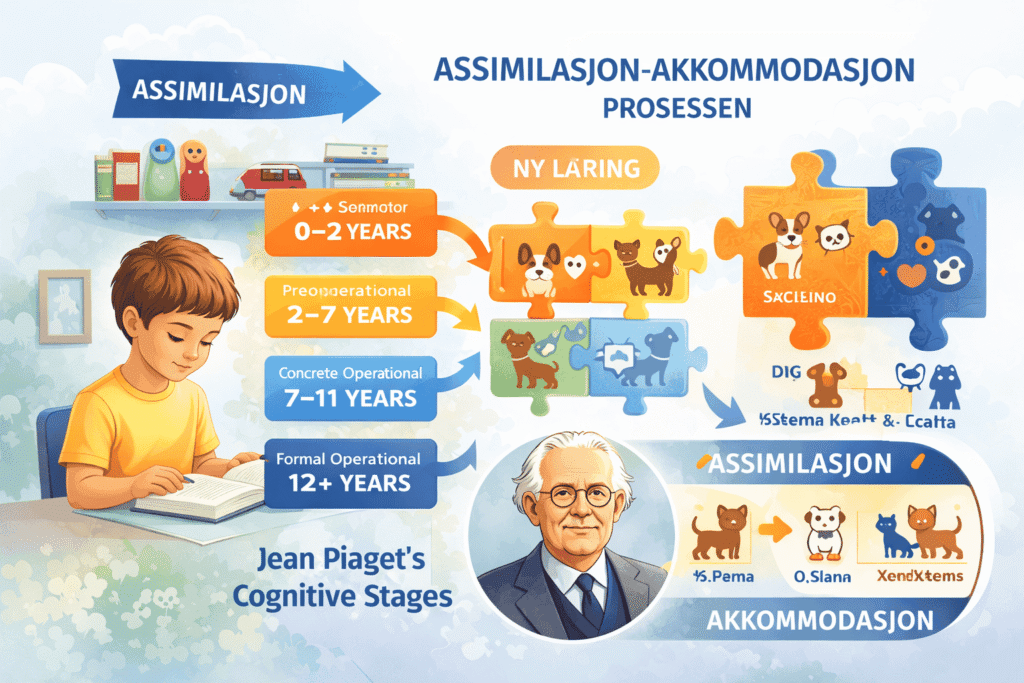
Jean Piaget, a renowned developmental psychologist, added assimilasjon as a essential part of cognitive development in kids. according to Piaget, kids analyze thru active interaction with their environment the use of two complementary strategies: assimilasjon and akkomodasjon.
Piaget’s Theory Explained:
- Schemas: Mental frameworks or patterns of understanding.
- Assimilasjon: New facts is added to current schemas.
- Akkomodasjon: Schemas are adjusted while new records doesn’t in shape.
Example in Childhood Development:
- A toddler knows the idea of “chicken” as a creature that flies.
- Once they see a bat for the primary time, they’ll initially name it a hen (assimilasjon).
- Later, they regulate their understanding to categorize bats separately (akkomodasjon).
Piaget’s Cognitive Stages and Assimilasjon:
| Stage | Age Range | Role of Assimilasjon |
|---|---|---|
| Sensorimotor | 0-2 years | Learning through sensory experiences |
| Preoperational | 2-7 years | Using existing schemas to interpret symbols |
| Concrete Operational | 7-11 years | Applying existing knowledge to solve problems |
| Formal Operational | 12+ years | Abstract thinking; integrating complex info |
Piaget emphasized that assimilasjon is essential for building knowledge gradually, forming the foundation for critical thinking and problem-solving.
Steps of Assimilasjon in Everyday Learning
Assimilasjon isn’t always restrained to childhood. Adults use it continuously. here’s how the technique generally works:
1. Encounter New Information:
Instance: Studying about a brand new software tool.
2. Relate to Existing Knowledge:
Compare with software you understand.
3. Integrate Information:
Add the new device’s capabilities to your intellectual understanding of similar tools.
4. Apply Knowledge:
Use the tool effectively based to your current knowledge.
5. Evaluate and Adjust if Necessary:
If the device behaves in a different way, minor modifications may also arise (mixing with akkomodasjon).
Examples of Assimilasjon in Daily Life
- Mastering new languages: Pertaining to new words to acquainted ones.
- Cultural edition: Information new social customs via familiar behaviors.
- Place of business mastering: Integrating new processes into present workflows.
FAQs
Q1: Is assimilasjon the same as getting to know?
A: Not precisely. Assimilasjon is a method of integrating new information into existing know-how. getting to know may involve assimilasjon however also consists of akkomodasjon and different cognitive procedures.
Q2: Can adults use assimilasjon efficiently?
A: Sure. Adults continuously use assimilasjon when encountering new technology, social norms, or paintings-associated responsibilities.
Q3: What happens if assimilasjon is overused?
A: Over-reliance on assimilasjon may also result in misconceptions, as one may forget about records that doesn’t match present schemas.
Q4: How is assimilasjon measured in psychology?
A: Psychologists have a look at assimilasjon by using looking at how people adapt new information to current cognitive frameworks, regularly the usage of experiments or developmental exams.
Conclusion
Assimilasjon is a key cognitive method that allows humans to understand and adapt to new reviews by means of integrating them into present expertise. From Piaget’s developmental stages to everyday getting to know and administrative center version, assimilasjon facilitates us navigate the arena effectively. At the same time as it works along akkomodasjon to refine know-how, expertise assimilasjon presents insights into how getting to know, memory, and cognitive growth arise.
By appreciating assimilasjon, educators, psychologists, and people can higher guide powerful studying and highbrow development all through life.